
The Unicorn and the Butcher

My dad came out to spend a few days with us which was downright fantastic and pretty cool.  Most of the time was filled with the common weekend stuff — family whatnot, some schoolwork (on a Saturday, no less) and an evening around a backyard campfire.  At one it was decided that the boys would go get some groceries from Meijer.  “The boys” include me, our sons, and my dad, affectionately known as Oompah to Mac and Zac.  Oompah is an honest attempt to pronounce Grandpa by a wee toddler, circa 2007.  It has since stuck and sticks well.  The nod to Gene Wilder and his orange staff is not unnoticed.

Anyway, we went to get some groceries from Meijer.  If you’re not familiar, Meijer is a Michigan-based chain of superstores that sells pretty much everything from housewares to food, clothes and even fine cutlery.  It’s a one stop shop.  Some Michiganders call it Meijer’s because 1) it was started by a guy named Fred Meijer and 2) we pluralize everything like this: Ford’s, Kroger’s, Penney’s, GM’s, Burger King’s, Taco Bell’s, and the seldom heard Taco’s bell.

We made an obligatory stop in the Halloween department, what with it already being September and the pre-Valentines sale already in progress the next aisle over.  They’re coming up with some rather creative costumes for kids of all ages, which means that juvenile boys who laugh at fart jokes are especially drawn to the absurdity of costume.  My boys tried every mask on and really explored the space.  A giant Trump face?  It fits and goes well with an on the spot monologue about twitter and walls.  A Hillary mask?  Sure thing — along with a sales pitch for her tell-all book.  And then they found the horse heads.

The horse head masks have been around for a few years but this was the first year that the boys noticed and engaged.  And engage they did.  Man, those things are creepy (the masks).  A long brown face that terminates with unavoidable protruding teeth, peep holes are hidden within the horse’s bowling ball eyes, and a flared snout that muffles the voice of the user.  Sounds cute, right?  If so, I did a terrible job of describing it.  It is odd and unsettling, like when they sell sushi at a gas station.

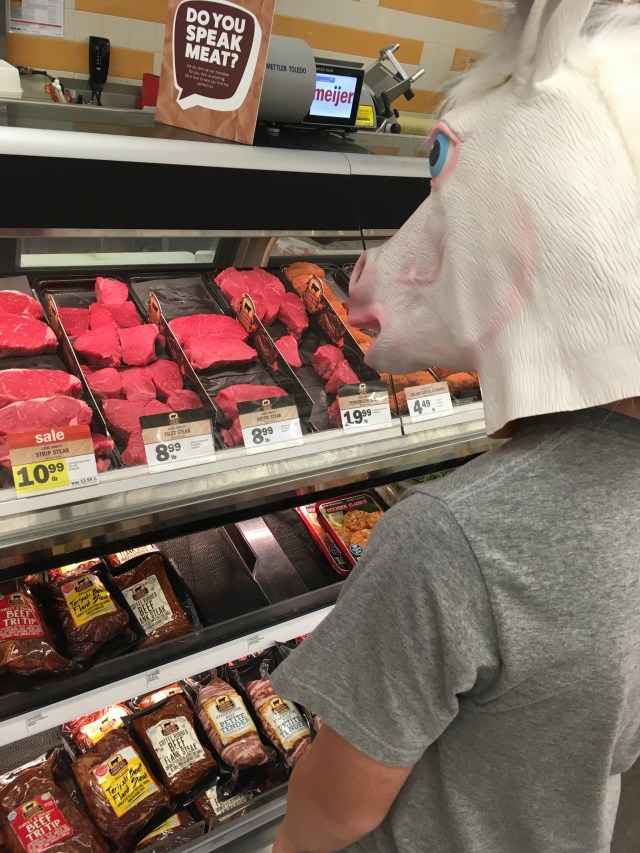
The horse mask was topped only by the overwhelming presence of the unicorn mask.  Similar shape and feel, but a different color scheme: the unicorn mask is white and features the single ring toss ready horn (perhaps horseshoes) and the eerie affectations of a mythical beast head, animated atop an innocent kid’s torso.  It was pretty funny. We laughed a lot.  Dad giggled his Bobby giggle — if you’ve heard it, you know — a hearty, almost stratospheric laugh.  Joy flowed.

Then Mac had an idea.  He said “Hey dad, let’s go over to the meat counter where the butcher guy hands out meat” and I thought “sure, what could go wrong?”  I often think this thought right before things go wrong.

First off, let me say that one of the best ways to draw a lot of undue attention to your family in a store is to have one of the kids don a plastic halloween costume horse head.  I asked him to take it off as we walked through the home improvement aisles, again by the dairy, and yet again by our grocer’s freezer.  People looked at us for a long time.  Children were intrigued.  Children were frightened.  Parents watched like hawks.  The chill parents with tats were like “Hey, Zelda — check out the horsey!” to their kid, while the soccer moms were less than thrilled overall.  Pretty standard generalizations, I know, but it all came to the surface again with horsey.

11 year old Mac finally made it to the butcher counter.  The butcher, hesitation in his voice, said to my son the unicorn “can I… help you?”  And MacUnicorn said “Yes, do you have any fresh unicorn meat?”  Note that he asks for fresh unicorn meat, which implies that unicorn meat is a typical thing and that the fresh stuff is really what you’d want for stew, the grill, magical incantations, etc.  The butcher, calm and overtly patient said “no, we do not have any unicorn meat.”  Mac, never one to abandon a potentially workable bit, pressed on: “do you think you’ll get any soon?”  Butcher: “No.”  Mac: “Do you know where I can get some fresh unicorn meat?”

At this point, I should tell you a couple of things that were running through my head.  First, I was really entertained by my son.  Part of this may have been my idea, especially the part about asking for fresh unicorn meat.  But I was unprepared as a parent and a writer for his persistence beyond the reasonable sustainabilty of his audience.  Our butcher was not impressed, partly because he knew he was on the wrong end of a prank and partly because meat cutting is (evidently) nothing to be mocked.  Butchers are national heroes.  When it comes to what part, precisely, it is that we’re eating, we can only take their word for it.  Remember this the next time you go to Outback Steakhouse.

But back to the meat counter, where MacUnicorn was truly oblivious to the growing frustration of his target.  Mac asked his closing question: “Well… do you know where I can get unicorn meat around here?”  And the butcher showed why he’s a national treasure.  Without missing a beat, he said in a gruff voice “Wal-Mart.”  And that, my friends, is a very funny butcher.  Kudos, my meat-cutting friend.  Kudos.

Dad and I laughed.  It was a moment of sheer delight and embarrassment.

On the way out of the store, I overheard the greeters at the door saying “you get all kinds in here…” and I felt a sense of pride.  It was my family — my children — who fueled an evening conversation at someone’s house that began with “how was your day?” where the butcher tells his poor wife that some kid came in and asked for Unicorn Meat, and how dumb it was.  Or maybe… maybe he was worried.  Maybe he called his butcher mentor and said “they know…”

The next day I saw someone in the lobby and they said “Pastor Adam, I don’t know if you recognized us, but we’re new to the church and we were at Meijer yesterday and saw your son…” and I was like “please come back next Sunday.”

Either way, a fun time and a good family memory.  I wanted to save it here on RadBlog.  Thanks for reading.
Posted in Family | 1 Comment

I am the Mario Generation

Our 8 year old Zac and I spend a few minutes each morning playing Super Mario World. I’ve had this particular SNES deck since high school, played it regularly in college — more than a few classes were missed because of Kirby’s Avalanche — and now my son and I bond over Mario.  If you’re wondering, it is indeed Zac who plays Mario and I Luigi.  As it turns out, I like Luigi over Mario 10 to 1.  Mario is a facade propped up by Luigi.  But nothing more to say on that right now.

A discernable refresh rate on our ancient lo-def TV

Here’s my favorite part of our 10 minute arcade escapade before school this morning.  Zac said “Dad, I like playing Nintendo with you because we bond over Mario.”  I said “Thanks, buddy!.”  He said “You grew up in the Mario generation.  I like that, Dad.”

What a good kid.  Dads: play old school Nintendo with your children.  You and I are, after all, the Mario generation.

Posted in Child of the 80's, Family | Leave a comment

September 11 — In Context

In his book The Younger Evangelicals, worship theologian and professor Robert Webber writes:

The younger evangelicals are marked in a very special way  by the events of September 11, 2001.  They know that the world will never be the same, that the ideals of prosperity and the hopes of a pre-September 11 world of peace will never happen.  The rise of terror by militant fundamentalists is marking their world and creating an ideological battle of religions.  Life will be marked by issues of peace and war, a new form of American patriotism, a wave of conservative political philosophy, and a more disciplined life.  This cultural setting is radically different than the cultural setting of the post-World War II generation, which was resolved to rebuild their world, and of the post-sixties generation, which was bent on breaking from the past and asserting their freedom to reinvent ethics, religion, and the church.

The postmodern September 11, 2001 world has led to the recovery of the biblical understanding of human nature.  The language of sin, evil, evildoers, and a reaffirmation of the deceit and wickedness of the human heart has once again emerged in our common vocabulary…

The  younger evangelical approaches humanity with a more realistic and biblical assessment of our estrangement from God.

Though Webber wrote these words just several months after the attacks, his voice has a tinge of the prophetic to it.  9/11 happened, yes, and it just so happened to be a critical turning point for what he calls the Younger Evangelicals.  According to his taxonomy, I fit into this category as a rare GenX/GenY line straddler.  We are the ones who were fresh to the launch pad of career (the final years of high school/college and the first full time jobs) when this happened.  It is a touchpoint of specific meaning for people who are now in their 30’s.  We had hoped it will be the last drastic terror attack.  It wasn’t.  It’s still going on globally.  But what about how this generation identifies in the church?  Webber continues:

The younger evangelicals freely acknowledge that they differ with the pragmatist’s approach to ministry. [They are] not attracted to “showy worship and things that please my felt needs.”

Fascinating.  My “felt needs” seems pretty shallow given the injustice and evil of the world.  The needs are, sadly, more obvious than ever! I don’t think Webber is saying 9/11 caused this transition, but he certainly pinpoints the event that forced (or perhaps enabled) a paradigm shift that has considerable reach into our spiritual lives.  The terror attacks became a tangible and universal expression of the kind of devastation sin brings to the world.  Thanks be to God for His coming Kingdom, btw.

Today we observe the 16th September 11th since the first one of major significance.  We can count on two things. First, the world is broken and sin has twisted everyone and everything.  Second, Jesus is the King of a Kingdom that reaches and renews the broken world.  Implication: this is the time to be the church, especially in a Post-9/11 world that knows evil incarnate in every memory of the planes, the jumping, the collapsing towers.  This breaks the heart of the Father.  He will not leave us in this situation forever.  There is hope that affects us now: the Kingdom of God is here.

Posted in Hot Topics, Worship Pastor Helpers | Leave a comment

Success & Horror Stories of Communication (COM211)

I’m preparing to teach COM-211 (Business & Professional Communication) at Cornerstone University. Right now I’m collecting stories from organizations where communication 1) went really well and it as a win or 2) things went really poorly and almost burned the place down. As you can imagine, there are more horror stories than there are success stories, which goes to show just how under-appreciated effective communication truly is! It’s like the engine in my car: I don’t really think about it until something goes wrong, yet, like organizational communication, it requires regular maintenance and intentional care.
Communication theorists Watzlawick, Beavin, and Jackson wrote an often-quoted (and really clunky) phrase: “One cannot not communicate.”

I’m excited to spend five weeks with a cohort of working adults as we help each other with the ever present and ever relevant topic of organizational communication. If you have any success (or horror) stories of miscommunication in the workplace that will help the class, please change some names to protect the innocent and share.

Posted in COM211 | Leave a comment

The Hospitality of God

Fall 2017 is here. Students are back in school, college football is back, the weather is making the slow turn toward Autumn and the trees are swapping their traditional green for an unpredictable mash of yellow, orange, brown, and firey red — an offset array magnified by the intense angle of the sun against a slate grey backdrop, where the clouds appear threatening but offer no more than an offsetting contrast.  Our eyes hurt as nature turns up the color knob to 11, a last hurrah before our section of earth succumbs to another ubiquitous white winter.
This is the time of year when people make the call to get back into a new rhythm that they once knew before June hit, back when the kids got up early and the evenings were jammed with homework and brushed teeth before 8pm and those classic Tuesday morning panics when you can’t find matching shoes — one shoe red with white stripes, the other black with grey shoelaces, both right foot.  Then it all slowed to a smooth wave when school switched to off.  We had our three months of reprieve, and now school’s back in session and undeniably better than ever.  We’re all one year older and one year wiser, yet it still takes time to adjust as we recall exactly how all this works and who goes where and when.  It can be overwhelming and a bit disorienting.  Thankfully the trees try to cheer us up with wild variety.  Some days are cloudy and warm, others are well lit and freezing. It looks warm but smells cold outside, and hoodies are the norm at even formal events.  Apple Cider — not apple juice — is the drink of the month, and pumpkin spice is the flavor of the season.
We get really feisty about flavors, don’t we?  You can tell quite a bit about a person by asking their opinion about black licorice.  They usually love it or hate it.  I’ve never met a person who puts themselves on the fence.  It’s the same with ice cream flavors.  Can you remember ever asking someone what flavor of ice cream they want and hearing them say “whatever”?  Me neither.   I’m not sure if Neapolitan brings us together or tears us apart. I’m the guy who only eats the vanilla third, leaving the chocolate and strawberry for those who might appreciate it.  And yes, they do have pumpkin spice ice cream.  I have a friend who doesn’t like mint flavored toothpaste, or any other kind of grownup flavor toothpaste, so he uses kids toothpaste.  His toothpaste has Elmo on it and comes out of the tube all sparkly and enchanted.  I’m no dentist but I think he’s got good teeth, better than mine, so I’m not one to judge.  I only bring this up because I wonder if he’d like Pumpkin Spice toothpaste.
If you started a new semester, welcome back.  If you were on vacation for the summer and you’re home now, welcome back.  If you’re jumping back into church, into rehearsals, into games, welcome back.  I welcome you back.  Pumpkin spice welcomes you back.
It feels good to be welcomed.  When someone offers a welcome, they ease all the tensions of the new.  When we hear the welcome, we know its okay for us to be there, for us to intrude on a turf we haven’t seen in a while… or maybe ever.  It’s an invitation to engage, to enter without reserve, to be at ease.  It clarifies that our presence is not a hassle but a delight.  Nobody likes to feel like an inconvenience, or, worse, to be unacknowledged.  We are wired for hospitality, both to give it and receive it.
God made us for hospitality.  According to dictionary.com, hospitality is “the friendly reception and treatment of guests and strangers… of treating guests and strangers in a warm, friendly, generous way.”   God is like this: friendly, warm, generous.  We are made in His image, which explains why we respond positively to hospitality and negatively to unfriendliness.  If you want to snub someone, you aren’t ‘hospitable toward them; you’re inconsiderate and dismissive, and hopefully they get the point.  I know you’re not like this, and neither am I, but I’m sure someone in history has used that tactic.  We were made in God’s image, but that image is tarnished by sin.  So now, instead of hospitality, we have a world that is mixed on the reception of fellow humans.  People can be trusted, but not always.  People are generally safe, but not everyone is a good guy.  I might let you into my house, but only after you pass a background check.  Our guard is up in our culture.  Too many bridges have been burned.  People are robbed, taken advantage of, killed.  Hospitality is usually kept under a thin shield that only lets the perceived non-threat into our world, and we into theirs.  It is a broken world where we, generally speaking, don’t trust each other all that much.  We teach our kids not to talk to strangers.  We keep our windows rolled up.  When someone knocks on the door, we peer out the window or peek through the peephole and make a judgement call as to whether we’ll open the door or not.  Hospitality is conditional; the welcome is offered under certain circumstance.  A few bad eggs have ruined it for everyone, and now we have to take our shoes off at the airport.  It shouldn’t be this way.
Just as we don’t fully trust people and they don’t fully trust us, at least when we’re strangers, we sometimes treat God with the same distance.  We’re not sure what He wants from us, so we keep the shields up.  Whether or not we’ll be welcome in His presence is unknown, and the risk is simply too great.  It’s easier to ignore the hospitality of God than it is to take the risk and enter in, just as it’s easier to not offer hospitality to Him.
Isaiah 40 describes a God of comfort, justice, forgiveness, and protection.   When God speaks to us, He speaks words of hospitality: generous, welcoming, warm. He knows that we’re made fragile by the brokenness around us and in us.  He  takes the gentle approach, giving us a moment to realize Him as Holy yet approachable. He simply says “come here, if you want, and find what you need” and “why not give your life to something bigger than yourself” and “I can give you a purpose, an eternity, and I can take care of the biggest problem you’ve got, which is sin.”
That’s no fun to talk about: our problem — biggest of them all — is sin.  Yet God says “your sins are paid for.”  What a strange thought. Why start there?  Seems like a soft yet confrontational opening.  Perhaps it needs to be.  God grabs our attention by speaking to our souls without sugarcoating it, somehow balancing grace and truth like a level scale.  In our brokenness we need the gentle touch, but we also need a frank diagnosis that got us into this mess.
Jesus Christ comes as the lamb of God to take away the sins of the world, as far as the east is from the west.  But He doesn’t do this without our being involved and owning up to the fact that we’ve sinned.  Rather, in His gentle, shepherd-like way. He calms us and corrects us both, making sure we don’t topple over a cliff edge or find ourselves in the jaws of the wolf.  It’s like He cares enough to protect us and push us.  Just like a good shepherd does.
It’s because of the hospitality of Jesus that we are welcomed into His presence.  At the same time, He looks for our hospitality as an open door to His presence.  He stands at the door, but He knocks and waits for us to say “come in!” with the same warmth and generosity He shows us.  Why would Jesus be so bold yet polite?  Grace & truth… comfort & conviction… health through holiness.  Freedom to choose, to love, to surrender.  If He forces His way in, we don’t have much choice but to surrender, do we?  He’s far more loving than that, and He respects His Imago Dei in us, the image which gives us the freedom He intended while also giving us the identity we lost in the fall.
God is hospitable.  Jesus welcomes us into His presence with open arms.  The Spirit moves in our hearts to say in return “come in…” and we find ourselves as sinners in the warm, gentle presence of the King.
This is amazing grace.
Will we welcome Him?  Will we welcome not only His presence but His Lordship?   Will we surrender to His hospitality?
Will we welcome the stranger?  Will we display the hospitality of God to the world, saying “He is here, He is here, and He is good, not wanting anyone to perish…”
That sounds both gentle and blunt, doesn’t it?  Just like Jesus.
Posted in Preaching, spiritual formation | Leave a comment

Strange Matter Coffee, Lansing

Had a few hours between things and spent those hours st Strange Matter for some coffee. Atmosphere was good, very simple layout, not super noisy, plenty of crowd turnover. The decaf latte was smooth and didn’t last long enough, but that was kinda my fault. Plentiful outlets and comfy seating. A good place to be!

Posted in Uncategorized | Leave a comment

SAU Alumni Board

Today was our semi-annual… or is it bi-annual?  It’s the one that means twice a year, so I think I mean bi-annual… Alumni Board Meeting at Spring Arbor University.  I graduated from SAU in 2002 and again in 2008.  Yes, twice, but not because I had to do it over again; these were just different programs and degrees.  Looking back, I see how Spring Arbor impacted my life in profound ways, from the academic training to the relationships with friends and professors, and especially the spiritual formation that I experienced.  I met my wife there, became who I am there, realized a bit more about the world, and ended up as a committed lifelong learner.  One might say I’m a fan, and a grateful one at that.

Over the past few years, I’ve had the privilege of serving on the Alumni Board of Directors.  With an alumni base of 30,000 graduates, SAU has an extended presence and impact felt around the world through the work of business owners, teachers, social workers, nonprofit leaders, ministers, CEO’s, musicians, artists, writers, accountants, counselors, stay at home parents, executive directors, administrators, salespeople, and probably a few bakers, some dentists, and a gaggle of attorneys.

Our job on the Alumni Board is to help SAU stay connected to our alums.  When I was an undergrad, it felt like I was supposed to be there to put in my 4 (5) years and then get the whole career thing going.  Little did I know how often I would look back and realize how formative college was for me.  You love a place like SAU more and more with every passing year.  Now that I’m 37 (38) I feel compelled to help the impact continue.  This week marks the beginning of another semester.  Most are returning students who know about certain profs and where not to park, but some are brand new freshmen who reached out one day and asked for more info.  Suddenly they’re moved into a dorm room with a little clip fan and a laundry basket, and a stranger who will soon be a friend.  They have no idea how awesome (yet challenging), how exciting (yet challenging), how fun (yet challenging) this journey shall be.

If I could go back and talk to Adam ’98 as he’s moving his stuff into Ormston 4, do you know what I would tell him?  Nothing.  He’ll experience it all, one day, one semester at a time.  I might hint that 20 years later he would still care about this institution enough to serve on a board, but it won’t feel like work because of how much the place will mean to you.  I could tell Adam ’98 all that, but I think I’d just stick with “don’t be so committed to denim jean shorts, mate.”

Homecoming is just a few weekends away, and I’m really looking forward to it.  As a student, it just seemed like a bunch of old people infested campus for free hamburgers and conversations about buildings that don’t exist amongst equally non-existent horse drawn carriages.  But now I see that this is exactly what homecoming is: a coming home (if you will) of people who realize the impact of college and appreciate it enough to want to go back and visit, show the kids/grandkids, and express support for such a unique place.

If you graduated from SAU like I did, I want you to know that you have a bunch of advocates who spent the morning thinking strategically about how best to serve you and how to help our graduates feel an ongoing and positive connection to SAU.  Spring Arbor University is like no other place.  Our graduates are like no other graduate.  There are many colleges and universities in the world, and it’s no secret that higher education in general is undergoing a transition, if not a downright cleansing by fire.  This is the time for our alumni to remember and even celebrate a unique spot on planet earth.  I’m thankful to have a small connection and calling to support a place which was, for me, a life changer.


Posted in Spring Arbor University | Leave a comment

Power Struggle (Exodus 1)

Pharaoh’s murderous directive to drown every newborn Hebrew boy seems rather out of place in the bible, especially for a book written to proclaim the faithfulness of God.

You can find the story for yourself at the opening chapter of one of the oldest books of the Bible.  Exodus is an account of God’s faithfulness in delivering His people from slavery.    Their suffering was severe and their oppressors were evil.  It was an injustice based on racial fears, magnified by a history purposefully forgotten by a powerful leader.  How powerful was Pharaoh?  Powerful enough to take the threat of the Israelites seriously enough to legalize mass infanticide, all without a hint of remorse.

I don’t know what’s worse.  Is it the part where babies die by virtue of their race and gender?  Or is it the fact that a leader can have that kind of unchallenged power to begin with?

Actually, I think I know what bothers me most about this story.  It’s an age old question:

Why does God let bad things happen?

It seems to me like this is the master question for all suffering, be it Hebrew Infanticide or any other evil injustice carried out on planet earth.  This is what I wrestled with as I worked through Exodus 1:8-2:10, which happens to be the Old Testament reading for the Revised Common Lectionary for this coming Sunday, August 27, 2017.

Listen: I’m a pastor, so I know the “answers” and even find myself dishing them out.  Stuff like “well… God works it out for the good…” or “we just have to trust…” and the like.  But cliches weren’t cutting the mustard today (another cliche).

I started asking God really hard questions about injustice, evil, and suffering.

Bad idea.

He first reminded me that as a white male in a rich country, I know very little about suffering compared to the majority of the world, let alone recent and ongoing racial injustices we see carried out in this nation before our eyes every day.  With gratitude and a renewed fire to push back against the injustice of racism, injustice, and the disgusting hatred on display which knows nothing of the Gospel, I nevertheless kept asking God hard questions.  Though I didn’t hear God’s voice (what a terrifying thought), I was impressed by a clarifying truth as it washed over me:

There’s a difference between having power and embodied power.

In this story, Pharaoh has power.  It is a real power based solely on fear and the risk of losing control, and it is potent enough to kill innocents en masse.  But that doesn’t mean that God loses His power, right?  In fact, that’s the reason for our question: if you, Lord, have power, why don’t you overcome Pharaoh?  But that, too, was the wrong question.

Pharaoh has power, but God is power.

God is power.  Pharaoh has a few seconds at the controls, but God is power.  Pharaoh has a limited authority because of God’s limitless power.  Pharaoh has some sway at that moment of human history, but God is God, and God is power, and all of human history belongs to Him.

So, then… why does God entrust bad guys with power?  I’m going to avoid the cliches here and just acknowledge the mystery of divine will and human freedom.

Are you reading this?  If so, congratulations: you have power!  Not just electrical, either.  You have some level of autonomy, a freedom to choose to read and an energy to read it.  Who decides what you do with this power?  You do!

Pharaoh made a really bad decision on what to do with his power.  He’s a free agent who chose evil.  But God, who is power, will bring justice and carry out His plan.

People suffer because evil people have temporary power.  God is power: eternal, permanent, good  There is no evil that will overcome the power of God, because every evil carried out by temporary power will be exhausted.  Evil lost on Easter Sunday.

I suppose, cliche as it sounds, that everything will be ok!  Still… let me press more:

Our tendency is to seek comfort over justice, and that’s not the social reality of Kingdom of God.  

No, this approach simply won’t do because it’s far too safe and, quite frankly, underwhelms the audacity of the Gospel.  This isn’t just about finding peace for yourself.  It’s a post about fighting for peace in an evil world.  Do something — with the temporary power entrusted to you — to bring reconciliation, healing, and life.  That’s the way of the Kingdom and its citizens.

I often wonder if God bugs me with stuff like this so that I despise my own comfort.  The more I think about it, the wiser it seems to include this story in the bible because it’s like real life: raw, heartbreaking, motivated by fear, and makes God look bad.  But God is not silent in this.  It’s like He’s saying “here’s what happened, here’s what I did, here’s how I win.  Join me.”

Sounds remarkably uncomfortable.  It challenges my own clamoring for power and autonomy.  It dissuades me from trying to build an empire for myself.  And, most uncomfortable of all, it takes a question about human suffering and compels me to be part of the solution.  Christ is victorious, and that should be apparent now in how I live and what I fight for.

Yes?

Posted in lectionary | Leave a comment

Who is Communion For?

Losers.  Communion is for losers. And imperfect people, like the ones who microwave fish for lunch in the office kitchen, and those who slander and gossip and kill and destroy, and for people who hate dogs and love cats, or the other way around.  Communion is not for the good person, the religious elite, or the ethically pure.  No one is born ready for communion.  Everyone is born not ready for communion.  We are unworthy, which is both offensive and a relief, because it finally puts a label on what we know is true about ourselves anyway.

Communion is for drunkards, fornicators, boasters, liars, politicians and pastors.  Communion is meant to provide what’s not there.  Communion is not an addendum to some preexisting bread and wine that perfect people produce.  Go ahead, try and make yourself as good as Jesus on your own strength.  Good luck, chuck.  Or Dave, Hildegard, or Kevin.

Nah, you don’t come to this table with any credential but Christ. There is no other name, no other way but Jesus and He alone.  As far as ancient teachers are concerned, He’s more relevant today than anything being pumped out by the culture machine or the rabid hurting human heart.  He’s meaningful to us because He’s not us.  Yet He is us.  The right version of us.

Martin Luther got something right when he said “sin boldly.”  Sounds crazy, right?  Not when you back up and see the whole picture.  Says Luther:

Be a sinner, and let your sins be strong [or sin boldly], but let your trust in Christ be stronger, and rejoice in Christ who is the victor over sin, death, and the world.

The dude gets it.  There’s no point in pretending our sins are so innocuous.  Whenever we sin, we offend a holy God and hold something against the Imago Dei in us.  Why pretend like we could sin in any other way but boldly?

There is One yet bolder who has given Himself completely, sacrificing all so that we might come and partake of His most precious body and blood, and proclaim His death until He comes again.  His victory is the only True victory, and its by faith in Him that we attain the same.

Attention, fellow losers: Christ has won.  Let’s remember, eat, celebrate, and live differently as losers loved by God who have won by what appears to be, from initial observation, some kind of spiritual loophole.  What but God’s generosity and immaculate grace would bring about such a re-ordering of the world?


Posted in Church Year, Worship Pastor Helpers | Leave a comment

Metal of Honor

I watched the livestream of today’s Medal of Honor ceremony, an award which is bestowed on members of our military who displayed great courage, performed acts of valor, and stepped up to the call of duty in such a way that the world is better because of their service.  Army medic James McCloughan, who I don’t know directly but indirectly through his family, was rightly honored and celebrated, and I’m inspired by his story of bravery in Vietnam.

The last things anyone would ever want to see are the first things that an Army medic sees, especially when an entire platoon is under ambush.  His is the story of a hero, a hero through and through, and his bravery nearly 50 years ago means that some of his fellow soldiers who would’ve otherwise died that day made it out alive.

I imagine what it would be like to be a hero of his caliber.  This isn’t IronMan, nor is it Captain America.  If anything, it’s Captain America in real life.  What would it be like to know that you are the reason others are alive, and that you saved them voluntarily and at great risk to yourself?  Can you imagine?

Yet I also imagine what it would be like to be one of the guys James lifted off the battlefield, the gauze from his pocket holding my innards as he carried me to safety with his blood-stained hands.

Which one would you want to be?  The hero or the saved?  My hunch is that we’d all choose the role of the hero rather than that of victim.  But we don’t have any control over that, do we?

Do we?

It seems that this man made a decision long before he saw the battlefield.  Called to serve his country, he simply served his country.  It was his decision to serve that carried him — and others — to safety.  His commitment was stronger than his inclination for self preservation, and, even more impressively, stronger than his commanding officer who ordered him not to go back in and get more wounded soldiers.  He went anyway.

So, in some sense, no, we don’t have control over what role we will play when life throws us into a battlefield, be it victim or bystander. But we do have some sway over how we will carry ourselves in the yet-seen opportunities to do something heroic.  No, I probably won’t serve in a battlefield, and I’m not looking for a medal, but I will be faced with countless opportunities to be part of the solution when a problem arises.  What can I decide now that might make someone’s day… or save their life?

You know, free will isn’t all it’s cracked up to be!  It’s nice to be able to do whatever we want, but it’s also true that very few things will force us to act beyond the basic demands of our own life and comfort.  Sure, I could help my neighbor with a flat tire, but nowhere is it written that I absolutely must.  I may have the opportunity to step out of my comfort zone and do the thing that brings life and healing, but very few things (if any) would force my hand.  And sometimes I want to stay silent, which only maintains the damage of our broken world.   I’m free to just stand there but I’m also free to do something.  The role of the servant requires a decision in advance, well before the opportunity arises.

I’m grateful for the ones — Army medic James McCloughan, especially — who made the decision to serve and carried it through.  Watching him receive the Medal through my tiny iPhone screen, I felt close enough to be genuinely inspired.  And it seemed like something needed to be said, even owned up to, by me.

James McCloughan did the right thing, and that seems like a good way to live.

Posted in Hot Topics | Leave a comment